- Distinguished Lecturer, April 22th
- Mt Carmel Auditorium
- (Sir) Dr. Christopher Lange, Professor of Physiology and Biophysics, SUNY Downstate Medical Center
- Latest Research on Stem Cells
- Prof. Lange’s entire career has dealt with understanding the mechanisms of how ionizing radiations affect molecules (especially DNA and the induction and repair of double strand breaks), how the kinetics of those changes affect cell survival and how changes in cell survival determine the survival of tissues, organisms, and tumors. This has led to many seminal works, often more than a decade ahead of the field. These studies have also shown the importance of radiation research in many other fields of science (physiology, cell biology, structural biology, genetics, biophysics, polymer physical chemistry, etc.) and medicine (radiation oncology, sonography, etc.). With a National Cancer Institute Research Career Development Award (1972-77), Lange showed that double-strand breaks (DSBs) in the DNA double helix are reparable in mammalian cells (previously they were thought to be irreparable and lethal). Most recently, he has addressed the necessity of hippocampal neurogenesis (from neural stem cells) for the therapeutic action of antidepressants in adult non-human primates. Please come and hear this esteemed Professor of Physiology & Biophysics from the SUNY Downstate School of Graduate Studies from SUNY Downstate Medical Center.
Friday, February 28, 2020
Latest Research on Stem Cells April 22th
Spring Seminar: Latest Research on Stem Cells

Thursday, February 20, 2020
“The Nondestructive Assessment of the Internal Condition of Trees” by Dr. Robert Marra
Spring Seminar: “The Nondestructive Assessment of the Internal Condition of Trees” by Dr. Robert Marra, Assoc. Agricultural Scientist, CT Agricultural Experiment Station
- Feb. 27, 2020 4:00pm
- SC 120
- Dr. Marra has expertise in plant pathology, mycology, fungal genetics, population biology, evolution, and molecular biology. While forest pathology is his principle research interest, Dr. Marra studies a range of plant pathosystems from various perspectives, including population biology, ecology, and mating system evolution. Dr. Marra earned a BS from SUNY-Binghamton (1990) in Biology/Russian and a PhD from Cornell (1998) in Plant Pathology/Mycology.
- Dr. Marra has developed knowledge and expertise in the use of a new technology for nondestructively assessing the internal condition of trees, identifying cavities, rot, and incipient decay, long an elusive goal of forest pathologists, arborists, and others interested in knowing the extent of internal decay and defect in trees. The advent of tomographic technologies has made this goal attainable. Similar to CAT scans used in medical diagnostics, sonic and electrical impedance tomography use sound waves and electrical currents to detect irregularities in structure and composition, as well as water content. Combining the results of both types of measurements can result in a remarkably accurate depiction of the tree’s internal condition.
Thursday, November 14, 2019
Fall Seminar: How Does Breast Cancer Hijack Mammary Development? by Dr. Jerrica Breindel
Fall Seminar: How Does Breast Cancer Hijack Mammary Development? by Dr. Jerrica Breindel
Dr. Jerrica Breindel Biomedical Science
December 5, 2019 3:00 pm Buckman Theater
The mammary gland is a unique organ that develops almost entirely after birth and also undergoes significant change during pregnancy and breast feeding. Cellular signaling programs that control normal growth and turnover in the adult gland may influence breast cancer formation and progression. My research is focused on learning how the cells of the mammary gland are regulated during development and how dysregulation of these cells can lead to different types of breast cancer.
Jerrica Breindel, PhD began studying cancer biology during graduate school at Yale University, focusing on how advanced lung cancers become drug-resistant. Dr. Breindel then completed a Postdoctoral Fellowship at Tufts University where she switched her research focus to the early stages of cancer development, before it can be detected.
Dr. Jerrica Breindel Biomedical Science
December 5, 2019 3:00 pm Buckman Theater
The mammary gland is a unique organ that develops almost entirely after birth and also undergoes significant change during pregnancy and breast feeding. Cellular signaling programs that control normal growth and turnover in the adult gland may influence breast cancer formation and progression. My research is focused on learning how the cells of the mammary gland are regulated during development and how dysregulation of these cells can lead to different types of breast cancer.
Jerrica Breindel, PhD began studying cancer biology during graduate school at Yale University, focusing on how advanced lung cancers become drug-resistant. Dr. Breindel then completed a Postdoctoral Fellowship at Tufts University where she switched her research focus to the early stages of cancer development, before it can be detected.
Wednesday, October 30, 2019
Fall seminar Doing Cool Chemistry with Cold Physics by Dr. Douglas Goodman November 20, 2019 11:00am Buckman Theater
Fall seminar Doing Cool Chemistry with Cold Physics by Dr. Douglas Goodman November 20, 2019 11:00am Buckman Theater
Dr. Douglas Goodman Assistant Professor Physics
November 20, 2019 11:00am Buckman Theater
Modern laser techniques can provide quantum-limited control of an atom or ion’s electronic state during a chemical reaction. Results of one such experiment examining laser-controlled charge-exchange reactions between co-trapped cold sodium atoms (~500 uK) and calcium ions (~100 K) will be presented. The study demonstrated how the reaction rates of individual entrance channels can be measured and manipulated by controlling the reactants' electronic states and/or collision energy. Of the channels studied, the Na[P] + Ca+[D] channel was the strongest with a rate constant ~10-8 cm3/s at an ion temperature of 200 K, which exceeds the classically predicted Langevin rate limit.
Dr. Goodman is an Assistant Professor of Physics at Quinnipiac University. He earned his B.S. at Trinity College (2006) and his M.S. and Ph.D. in Physics at the University of Connecticut (2015). Prof. Goodman's research interests are in the field of experimental ultracold atomic, molecular, and optical (AMO) physics.
Dr. Douglas Goodman Assistant Professor Physics
November 20, 2019 11:00am Buckman Theater
Modern laser techniques can provide quantum-limited control of an atom or ion’s electronic state during a chemical reaction. Results of one such experiment examining laser-controlled charge-exchange reactions between co-trapped cold sodium atoms (~500 uK) and calcium ions (~100 K) will be presented. The study demonstrated how the reaction rates of individual entrance channels can be measured and manipulated by controlling the reactants' electronic states and/or collision energy. Of the channels studied, the Na[P] + Ca+[D] channel was the strongest with a rate constant ~10-8 cm3/s at an ion temperature of 200 K, which exceeds the classically predicted Langevin rate limit.
Dr. Goodman is an Assistant Professor of Physics at Quinnipiac University. He earned his B.S. at Trinity College (2006) and his M.S. and Ph.D. in Physics at the University of Connecticut (2015). Prof. Goodman's research interests are in the field of experimental ultracold atomic, molecular, and optical (AMO) physics.
Thursday, October 17, 2019
Fall Seminar: Phaeocystis antarctica and the Marine Sulfur Cycle by Dr. Joanna Kinsey Nov. 7, 2019 1:00 pm Buckman Theatre
Fall Seminar: Phaeocystis antarctica and the Marine Sulfur Cycle by Dr. Joanna Kinsey
Dr. Joanna Kinsey, Assistant Professor Chemistry
Nov. 7, 2019 1:00 pm Buckman Theatre
The marine sulfur cycle has been studied extensively since the 1987 hypothesis that Earth’s radiative budget and climate was influenced by the ocean-atmospheric coupling of dimethylsulfide (DMS). The primary source of DMS is from the enzymatic lysis of dimethylsulfoniopropionate (DMSP), a sulfur-containing compound produced by several taxa of algae and corals. Phaeocystis antarctica, a high-DMSP producing algal species found in the Southern Ocean, can form blooms covering hundreds of km2 and ~23% of the primary production in high latitude (>60°S) waters. Coinciding with these blooms are high concentrations of sulfur and carbon compounds, that once in the dissolved phase, are readily consumed by heterotrophic bacteria, photolyzed, or vented to the atmosphere. This seminar will review the marine sulfur cycle and present current and future research on DMS and related compounds.
Dr. Kinsey joined the QU Department of Chemistry and Physical Sciences in August 2018. She received her Ph.D. from the State University of New York, College of Environmental Science and Forestry in Environmental Chemistry in 2014 and was a post-doctoral student at North Carolina State University. She has participated on several coastal field projects and six research cruises that include cruises to Antarctica and diving on the HOV Alvin submersible. Her research focuses on sulfur and carbon cycling in coastal and open ocean regions.
Dr. Joanna Kinsey, Assistant Professor Chemistry
Nov. 7, 2019 1:00 pm Buckman Theatre
The marine sulfur cycle has been studied extensively since the 1987 hypothesis that Earth’s radiative budget and climate was influenced by the ocean-atmospheric coupling of dimethylsulfide (DMS). The primary source of DMS is from the enzymatic lysis of dimethylsulfoniopropionate (DMSP), a sulfur-containing compound produced by several taxa of algae and corals. Phaeocystis antarctica, a high-DMSP producing algal species found in the Southern Ocean, can form blooms covering hundreds of km2 and ~23% of the primary production in high latitude (>60°S) waters. Coinciding with these blooms are high concentrations of sulfur and carbon compounds, that once in the dissolved phase, are readily consumed by heterotrophic bacteria, photolyzed, or vented to the atmosphere. This seminar will review the marine sulfur cycle and present current and future research on DMS and related compounds.
Dr. Kinsey joined the QU Department of Chemistry and Physical Sciences in August 2018. She received her Ph.D. from the State University of New York, College of Environmental Science and Forestry in Environmental Chemistry in 2014 and was a post-doctoral student at North Carolina State University. She has participated on several coastal field projects and six research cruises that include cruises to Antarctica and diving on the HOV Alvin submersible. Her research focuses on sulfur and carbon cycling in coastal and open ocean regions.
Thursday, April 25, 2019
2019 Regional Conference Poster Winners
Congratulations to the three 2019 regional conference poster winners!!
The NE Regional Sigma Xi Conference was held at Quinnipiac University on Wednesday, April 24th. Students from ANY discipline who are involved in a systematic investigation were invited and 55 abstracts were accepted and their posters displayed from 3-5 in the Burt Kahn Court. http://www.sigmaxiquinnipiac.org/


The NE Regional Sigma Xi Conference was held at Quinnipiac University on Wednesday, April 24th. Students from ANY discipline who are involved in a systematic investigation were invited and 55 abstracts were accepted and their posters displayed from 3-5 in the Burt Kahn Court. http://www.sigmaxiquinnipiac.org/

- Function of an Aging-Associated MicroRNA in Splicing Homeostasis in C. elegans. Liat Levy and Alexandre de Lencastre Dept. of Biomedical Sciences, Quinnipiac University; Dept. of Biological Sciences, Quinnipiac University

- The use of Multi-quadric interpolation in polynomial-based ENO stencil selection procedure: Challenges and Numerical Experiments in Matlab. Rahimyar Abdul & Dr. Stavros Christofi. Western Connecticut State University. non-Quinnipiac University Graduate student. Western Connecticut State University, Mathematics

- The Effects of Metformin on MicroRNA-71, Stress Resistance, and Aging in Caenorhabditis elegans. Kipp Hopper & Dr. Alexandre de Lencastre. Quinnipiac University Undergraduate student. Quinnipiac University Biomedical Sciences.
Wednesday, April 17, 2019
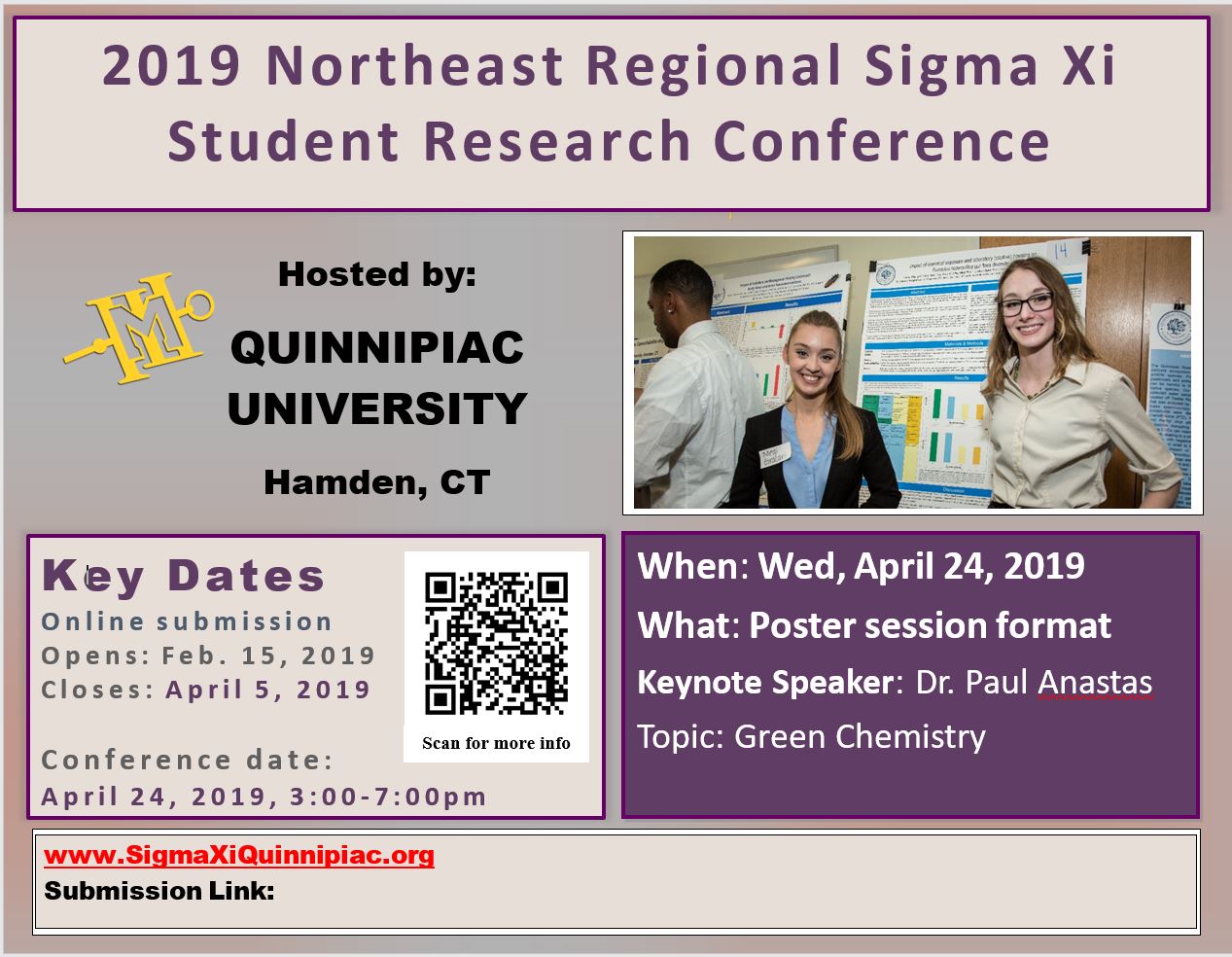
NE Regional Sigma Xi Meeting April 24th 2019
NE Regional Sigma Xi Meeting April 24th 2019
Conference Page: http://www.sigmaxiquinnipiac.org/p/ne-regional-meeting.html
Conference date: April 24, 2019, 3:00-7:00pm
The NE Regional Sigma Xi Conference will be held on Wednesday, April 24th in the Burt Kahn Court. Students from ANY discipline who are involved in a systematic investigation are invited. Students may present any aspect of their research (literature review, methods/procedures, manualized intervention, or final data, if finished). Trifold poster boards and clips will be provided for displaying posters on an easel or long table.
Conference Schedule
2:00-3:00: Set-up
3:00-4:00: Poster Session I
4:00-5:00: Poster Session II
5:00-5:45: Speaker Reception with Dr. Paul Anastas
5:45-6:45: Distinguished Lecturer Presentation Dr. Paul Anastas, “Green Chemistry”
6:45-7:00: Graduate and Undergraduate Awards Presentation
Conference Locations: Burt Kahn Court and Mt Carmel Auditorium
Conference Page: http://www.sigmaxiquinnipiac.org/p/ne-regional-meeting.html
Dr. Paul Anastas “Green Chemistry” April 24, 2019
Paul T. Anastas is a Professor in the Practice of Chemistry for the Environment. He has appointments in the School of Forestry and Environmental Studies, Department of Chemistry, and Department of Chemical Engineering. In addition, Prof. Anastas serves as the Director of the Center for Green Chemistry and Green Engineering at Yale. Anastas took public service leave from Yale to serve as the Assistant Administrator for the US Environmental Protection Agency and the Agency Science Advisor from 2009-2012. From 2004 -2006, Paul Anastas served as Director of the ACS Green Chemistry Institute in Washington, D.C. He will be the Keynote and Sigma Xi Distinguished Speaker for the Northeast Regional Sigma Xi Student Conference at QU.


Subscribe to:
Posts (Atom)